
CAEP Accountability Measures
Shepherd University School of Education &
Educator Preparation Program

CAEP Accountability Measures
School of Education / SU EPP Enrollment Demographic Data — As of Fall 2025
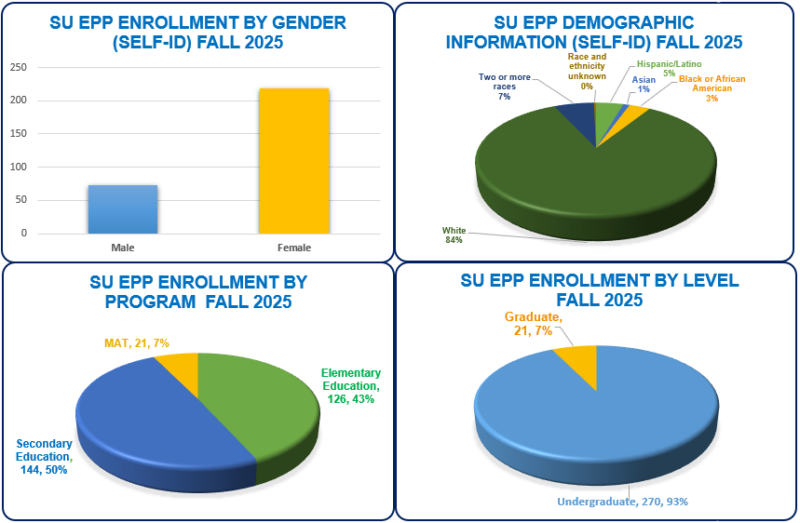
Source Shepherd University Office of Institutional Research (Fall 2025 Census Data)
For more Quick Facts about Shepherd University, click here!
MISSION: The Shepherd University Educator Preparation Program (EPP) utilizes data-driven instruction to prepare reflective, effective, and socially responsible teachers to meet the diverse needs of P-12 students. Rooted in learning, engagement, integrity, accessibility, service, and community, we cultivate innovative educators who apply research-based strategies, foster inclusive learning environments, and promote success for all students. Through rigorous coursework and immersive field experiences with community partners, we prepare our teacher candidates to be empowered educators who seek continuous improvement and lead in dynamic educational settings.
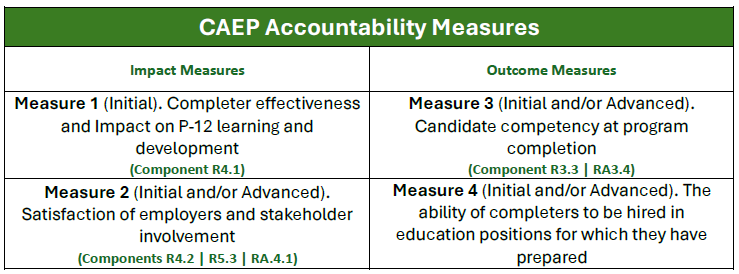
To ensure its effectiveness and quality across all specialties and disciplines throughout the program, the EPP at Shepherd University is committed to implementing and refining the process of continuing improvement and comprehensive assessment. Consequently, our efforts to certify we address the measures CAEP has established to ensure we are accountable to our candidates, our stakeholders, the university, and the public often overlap and are intertwined.
Consequently, many of the elements in the report below overlap and are intertwined as well as noted below.
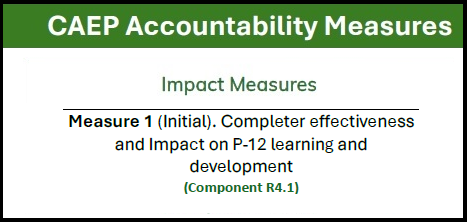
Measure 1: Completer Effectiveness and Impact on P-12 Learning and Development (Component R4.1)
According to CAEP, completers are identified as individuals who have “successfully satisfied all program requirements of a preparation program at least six months previously and who [are] employed in a position for which they were prepared for state licensure.” One means by which such individuals’ IMPACT on P-12 learning and development might be measured is through standardized assessments, a method that is implemented on both a district- and state-wide basis across West Virginia to measure such effectiveness and impact. For the 2024-2025 Academic Year, the EPP at Shepherd University collected WV General Summative Assessment (GSA) data for recent completers teaching in Grades 3-6 in the local area (e.g., graduated 2022-2024).Overall, completers from Shepherd’s EPP realized an average of 13% positive growth in their classrooms in both Math and ELA during the 2024-2025 reporting timeframe.

To supplement and fortify this state-wide assessment data moving forward, another means by which Completer Effectiveness and Impact on P-12 Learning and Development will be measured is through a Case Study in which the EPP is currently engaged. The Case Study involves recent completers at both undergraduate and graduate levels from various programs. Participants will develop a unit of study that includes pre- and post-assessments, formal observation and evaluation of instruction from Shepherd EPP Faculty, focused self-reflections on teaching and learning, and data-driven analysis regarding the impact of teaching and learning from the unit of study. [See SU EPP CAEP R4.1 Research Proposal Presentation v3] Initial data from this study will be available for the public in Spring 2027.
SU EPP CAEP R4.1 Research Proposal Presentation v3
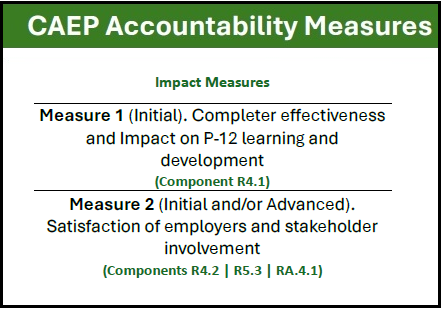
Measure 1: Completer Effectiveness and Impact on P-12 Learning and Development (Component R4.1)
Measure 2a: Satisfaction of Employers (Component R4.2)
The overall feedback received from employers in focus group sessions and surveys throughout the past three years, including surveys distributed directly by the Shepherd EPP specifically within the reporting timeframe (2024-2025), demonstrates significant satisfaction with our completers specifically regarding Measure 2a / Component R4.2 (see below). Indeed, anecdotally, P-12 superintendents, faculty, and HR representatives continue to make statements in multiple and various settings to indicate Shepherd graduates are highly sought-after as teachers and colleagues in and around the region. Such qualitative statements further support the initial quantifiable data provided above to reflect teaching effectiveness and positive impact on P-12 students’ learning and development [Measure 1 / Component R4.1].
By combining such qualitative data with the quantitative data collected from Local Education Agencies (See GSA Data above) as well as the current/ongoing Case Study, the EPP at Shepherd anticipates being able to provide significant valid and reliable data to the public regarding Measure 1 specifically as related to Component R4.1 in 2027 and beyond.
Measure 2a: Satisfaction of Employers (Component R4.2)
For complete background and history on the SU EPP Employer Survey, see SU EPP Employer Survey Background History (2a)
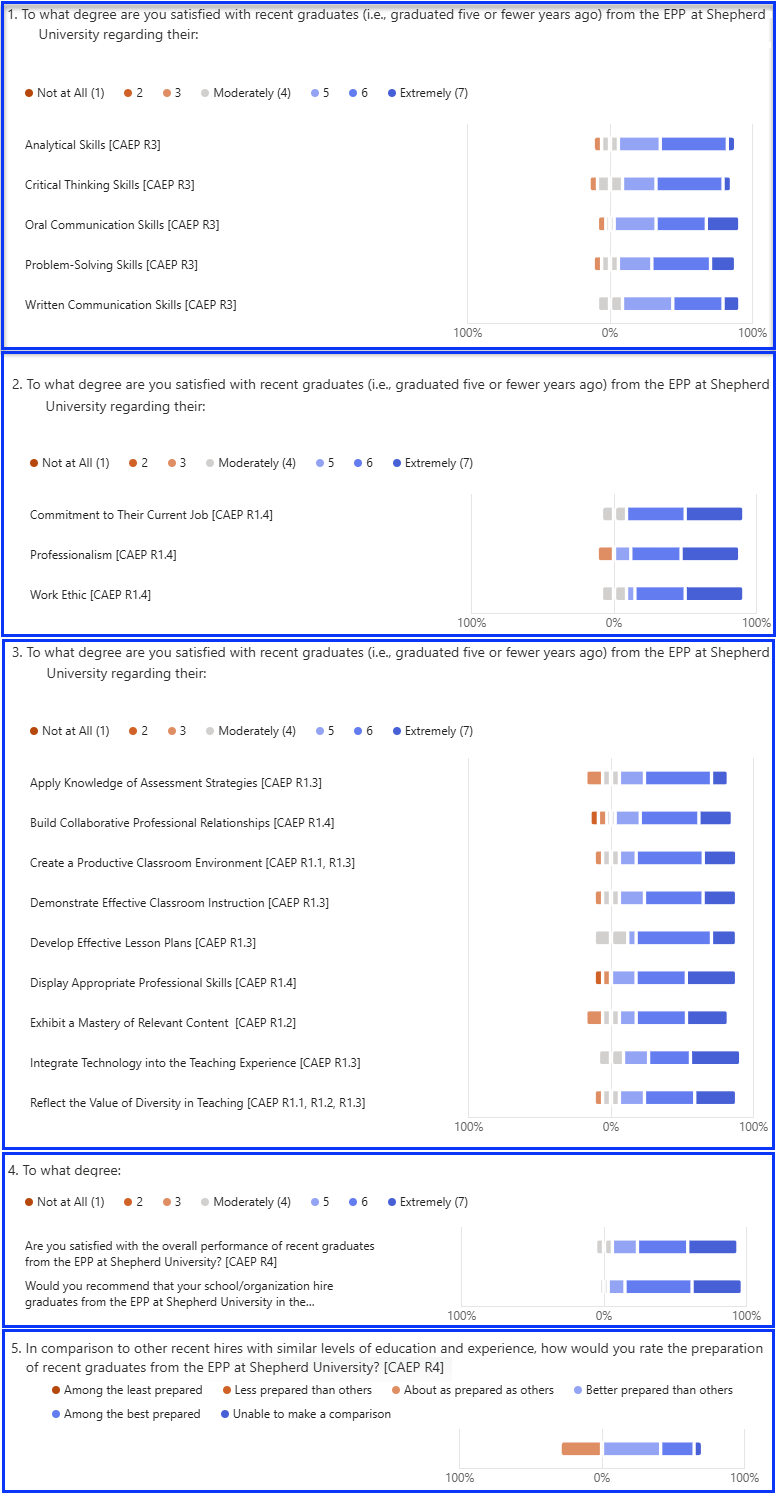
For the Spring 2025 Employer Survey, respondents reported overall satisfaction with completers regarding Standard R3 (Measure 2a [Component R4.2]). In response specifically to “the quality of candidates [as] a continuous and purposeful focus from recruitment through completion…[, the EPP at Shepherd] demonstrates that development of candidate quality is the goal of educator preparation” as identified on Question 1 via the Survey. On a scale of 1-7, responses overall averaged at 5.43 on a 7-point scale, with “4” indicating “Moderate” and “7” indicating “Extremely” (See below).
Regarding Standard R1 (Measure 2a [Component R4.2] and Measure 1 / Component R4.1), respondents reported an even stronger rate of satisfaction, with an overall average of 5.63 on the same 7-point scale (see below), for Questions 2-3 combined. These questions directly address Standard R1 components 2-4 as outlined herein (see below):
- 2 Content: The [EPP at Shepherd] ensures candidates are able to apply their knowledge of content at the appropriate progression levels. [The EPP at Shepherd demonstrates] candidates know central concepts of their content area (InTASC Standard 4) and are able to apply the content in developing equitable and inclusive learning experiences (InTASC Standard 5) for diverse P-12 students.
- 3 Instructional Practice: The [EPP at Shepherd] ensures that candidates are able to apply their knowledge of InTASC standards relating to instructional practice at the appropriate progression levels. [The EPP at Shepherd demonstrates] how candidates are able to assess (InTASC Standard 6), plan for instruction (InTASC Standard 7), and utilize a variety of instructional strategies (InTASC Standard 8) to provide equitable and inclusive learning experiences for diverse P-12 students. Providers ensure candidates model and apply national or state approved technology standards to engage and improve learning for all students.
- 4 Professional Responsibility: The [EPP at Shepherd] ensures candidates are able to apply their knowledge of professional responsibility at the appropriate progression levels. [The EPP at Shepherd demonstrates] candidates engage in professional learning, act ethically (InTASC Standard 9), take responsibility for student learning, and collaborate with others (InTASC Standard 10) to work effectively with diverse P-12 students and their families.
The Spring 2025 responses indicate a statistically significant increase in overall satisfaction when compared to what was realized in Spring 2024 in regard to these specific elements on the survey (see Employer Survey Background & History above for comparison). This is especially important considering there had been a reported decrease in satisfaction (albeit statistically insignificant) reported on these same factors between Spring 2023 and Spring 2024. [For a comparison across years, see SU EPP Employer Survey Responses R4.2 Combined Overview 2023-2025.]
Finally, as directly related to Standard R4 (Measure 2a [Component R4.2]), responses to the Spring 2025 Employer Survey indicate continued increased satisfaction with the overall performance of our candidates within the P-12 setting upon employment in our partner P-12 schools (Q4), with an overall average of 6.1 on the 7-point scale. Indeed, many respondents indicate that the candidates completing programs within the EPP at Shepherd are “Better prepared than others” or “Among the best prepared,” while others indicate our candidates are “About as prepared as others” when compared to other recent hires with similar levels of education and experience (Q5). [See below]
Measure 2b: Stakeholder Involvement (Component R4.2)
The Educator Preparation Program Council (EPPC) is the body that is responsible for educator preparation and teacher education at Shepherd University. The EPPC is chaired by the Coordinator of the Educator Preparation Program, Accreditation & Compliance [CEPAC], and is comprised of the following: School of Education faculty; all specialization coordinators; certification analyst; field placement coordinator; one student representative from each of the following programs: elementary education, secondary education, and MAT program; and one representative from each two-year institution with an active/signed SU collaborative agreement (e.g., community / technical colleges). The Ex-Officio member of the EPPC is the Dean of the College of Humanities and Social Sciences. In this way, the EPPC exemplifies how various stakeholders across the university and community share responsibility and authority in determining what is important in teacher education at Shepherd University. The EPPC, through monthly meetings (see minutes / below), administers, coordinates, evaluates, monitors, reviews, and revises the Educator Preparation Program at Shepherd University. The EPPC has the responsibility to ensure that all specializations are conducted in a manner that is consistent with the stated philosophy, theme, and objectives of the Educator Preparation Program [EPP].
The EPP at SU is also involved with our EPP Advisory Council (EPPAC), which is comprised of representatives from the EPPC (above) along with a representative/liaison appointed by the WVDE, public school administrators, P-12 classroom teachers (including SU alumni), and (ideally) community representatives. The EPPAC meets once each semester (e.g., spring and fall) [see minutes / below], serving as an advisory body to the EPP in developing and reviewing all programs and policies specifically for the preparation and licensure of new teachers. Per WVDE Policy 5100, the EPPAC “shall review matters as related to: new and revised preparation programs; admission, retention and exit criteria; pre-professional skills, including trauma-informed and social-emotional best practices, content specialization, and professional education assessments; educational technology activities and assessments; annual testing and supply/demand reports; WVBE and national program reviews and findings; WVBE educational preparation and licensure policies and statutes; recruitment of students; clinical and field experiences; and development of preparation of policies and programs for inclusion in WVBE self-study materials.” Furthermore, substantive program of study modification (e.g., [significant] addition or deletion of courses, significant changes in course content or clinical experiences) must be submitted to the EPPAC for review.
Other initiatives in which we include not only our various stakeholders (e.g., EPPC/EPPAC members, local and regional P-12 partners, current candidates, and alumni, etc.) include various focus groups as well as the aforementioned surveys that gather both quantitative and qualitative data in our ongoing efforts to ensure continuous improvement in general across the EPP as well as with focused and intentional initiatives. During the past three academic years (2022 – 2025), a variety of themes were identified across these measures. [See various Continuous Improvement, Focus Groups, and Survey Data Triangulation documentation below.] Efforts have been taken to address many of these identified areas of concern while others are currently being addressed and/or are planned to begin within the coming months. [See Continuous Improvement Efforts (2024-2027).
For more information on Stakeholder Involvement, please refer to the following documents (e.g., EPPC, EPPAC, and Quality Assurance documentation).
SU EPPAC Membership Roster 2025-2026
SU EPPAC Meeting Info Fall 2025
SU EPPC Meeting Minutes 2024-2025
SU EPPAC Meeting Info S2024 – S2025
SU EPP Continuous Improvement Efforts (2024-2027)
SU EPP Quality Assurance System
SU EPP Focus Groups & Survey Data Triangulation Document
SU EPPAC F23 Focus Group Continuous Improvement Priority Ranking Info
SU EPPC and EPPAC Meeting Minutes S2021 – S2025
Measure 2b: Stakeholder Involvement (Component 5.3)
Measure 3: Candidate Competency at Completion (Component R3.3)
The EPP at Shepherd University works closely with a variety of stakeholders within the university and the community as well as across the state and the local region to ensure our program not only meets but also exceeds our improvement and accreditation efforts each year (see below).
We strive for excellence in all we do, and that includes making sure our candidates are able to serve diverse learners in the P-12 setting around the region in whatever specialty they may choose, during their time at Shepherd (field-based/pre-clinical and clinical experiences) and beyond graduation / upon completion. We have developed various Memorandums of Understanding (MOUs) with schools/districts throughout the region, not only in West Virginia but into three other states (see below). We continue to work closely with our partner schools and P-12 administrators as well as our teacher candidates to co-select and evaluate both cooperating teachers and placement settings to ensure our candidates experience the best experiences possible [Measure 2b]. We survey teacher candidates regarding their practicum experiences throughout their culminating student-teaching/Residency experience(s), and we review and analyze that data to help guide the decision-making efforts to guide both field and clinical placements each semester [Measure 2b].

Stakeholder Involvement: Co-Selection Process / Yearlong Residency
Since the inception at Shepherd University of the culminating yearlong residency experience in 2019-2020 for elementary education candidates, we host open interview sessions each semester with the candidates who plan to enter the residency experience. These sessions include administrators from our local P-12 Partner schools in Berkeley and Jefferson Counties (WV), Frederick and Washington Counties (MD), and Frederick and Loudoun Counties (VA) as well as part of our continuing and developing co-selection process [Measure 2b].
Beginning with the Fall 2024 semester, all freshmen now enter the yearlong residency track per mandates in place by the State of West Virginia; by Fall 2027, all undergraduate candidates will be entering a yearlong residency rather than a traditional one-semester student teaching experience. For more information, click HERE.
For a complete background and history on the Yearlong Residency initiative, see
SU EPP Yearlong Residency Background History (2b).
Candidate Competency at Completion: Yearlong Residency
Fall 2024 – Spring 2025 Residency Placements
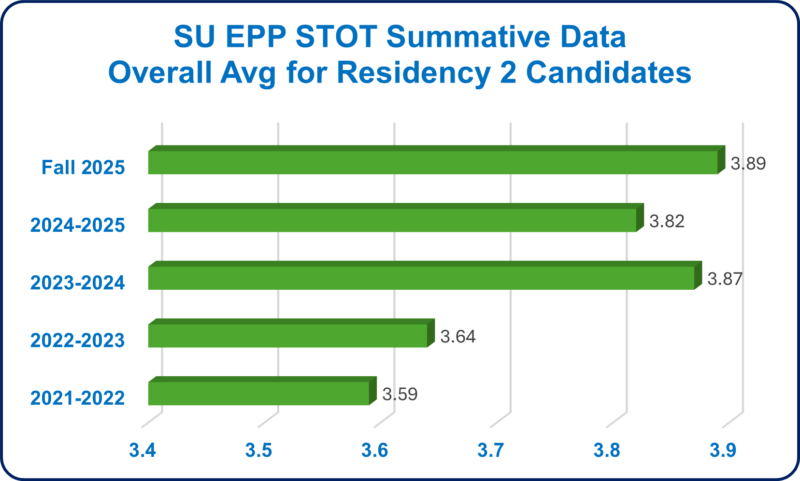
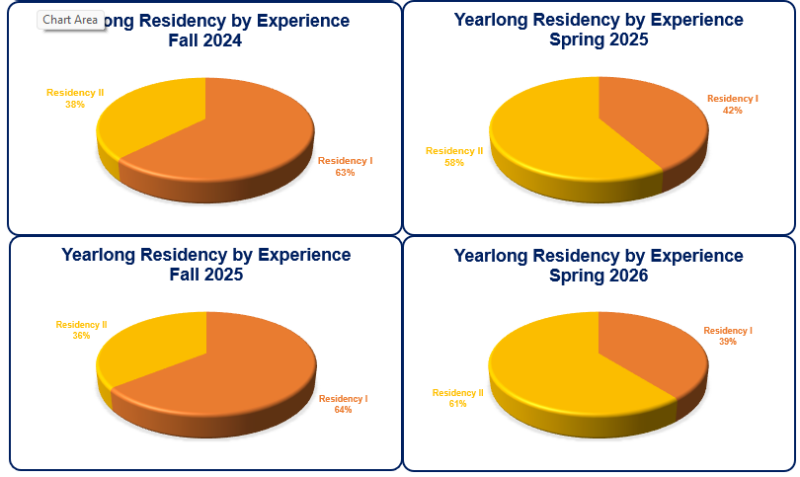
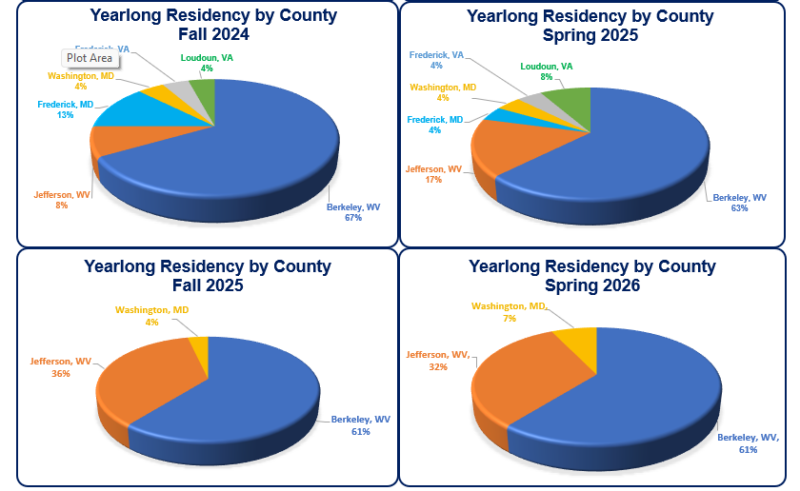
For the 2024-2025 academic year, Residency I and II candidates were placed in Berkeley & Jefferson Counties in WV as well as Loudoun and Frederick Counties in VA. The program was extended into both Frederick and Washington Counties in MD. The pilot for the secondary programs expanded to include art education candidates in addition to social studies candidates within the residency experience as well. For the Fall 2024 semester, we had a total of 15 candidates in the Residency I experience [13 elementary, 2 secondary (1 SS and 1 ARED)] and 9 candidates from the 2023-2024 AY returned to complete their yearlong experience in Residency II [8 elementary, 1 secondary (SS)]. In Fall 2024, 16 candidates were placed in Berkeley County, WV; 2 in Jefferson County, WV; 1 in Loudoun County, VA; 1 in Frederick, VA; 1 in Washington County, MD; and 3 in Frederick, MD. For Spring 2025, 14 candidates returned to complete their Residency II experience, while 1 of the elementary candidates opted to switch to the RBA program instead. Fifteen (15) candidates were placed in Berkeley County, WV: 4 in Jefferson County, WV: 2 in Loudoun County, VA; 1 in Frederick, VA: 1 in Washington County, MD; and 1 in Frederick County, MD. Although no secondary candidates opted to join the pilot in Spring 2025, 10 elementary candidates completed their Residency I experience [Measure 2b]. For 2024-2025, the 23 candidates who completed the Residency II experience scored across almost all areas at a level of “Distinguished” (4), with a few scoring above “Proficient” (3.5) on a few standards on the Skills of Teaching Observation Tool [STOT]. The candidates’ overall summative average was 3.82 by the end of their Residency II experience [Measure 3]. [See below.]
Fall 2025 – Spring 2026 Residency Placements
For the current 2025-2026 academic year, Residency I and II candidates were placed in Berkeley & Jefferson Counties in WV as well as Washington County in Maryland. For the Fall 2025 semester, we had a total of 18 elementary candidates in the Residency I experience, and 10 elementary candidates from the 2024-2025 AY returned to complete their yearlong experience in Residency II. In Fall 2025, 17 candidates were placed in Berkeley County, WV; 10 in Jefferson County, WV; and 1 in Washington County, MD. For Spring 2025, 17 candidates returned for their Residency II experience, while 1 of the elementary candidates was engaged in remediation for the semester. Although no secondary candidates opted to join the pilot in 2024-2025, 11 elementary candidates registered for their Residency I experience in Spring 2025. Seventeen (17) candidates were placed in Berkeley County, WV, including 2 who served as Clinical Teachers of Record (CTR); 9 were placed in Jefferson County, WV, and 2 in Washington County, MD [Measure 2b]. For Fall 2025, the 10 candidates who completed the Residency II experience scored across almost all areas at a level of “Distinguished” (4), with a few scoring above “Proficient” (3.5) on a few standards on the Skills of Teaching Observation Tool [STOT]. The candidates’ overall summative average was 3.89 by the end of their Residency II experience [Measure 3]. [See below.]
Measure 3: Candidate Competency at Program Completion (Component R3.3)
The EPP at Shepherd University measures Candidate Competency at Program Completion in a variety of ways. The primary indicator of our candidates’ competency within their respective content areas are their course grades and GPAs within their professional & specialty studies courses (e.g., no grades below “C” in those courses & a minimum 2.75 GPA, with a 3.0 minimum GPA in the final clinical semester). An overall content-area GPA of 2.5 is required by WV Policy 5100, while the EPP at SU has set the minimum at 2.75 to be admitted to the EPP (Juncture 1), to qualify for the final clinical practicum (Juncture 2), and to be recommended for licensure (Juncture 3). At each Juncture point (e.g. “Gateway”), each individual candidate must also maintain a minimum overall GPA of 2.75 with no grade lower than “C” in their professional & specialty studies courses. [NOTE: Professional studies courses are those defined as “Courses beginning with [an] EDUC prefix required for certification in different fields of study.” Specialty studies are “[t]ypically, those content courses required for certification in different fields of study (e.g., Multi-Subjects K- 6, Social Studies 5-Adult, etc.).”] Per the nature of the policies in place within the EPP, 100% of all candidates meet or exceed this requirement throughout the EPP & at program completion. Additionally, the EPP at Shepherd has determined that all candidates by program completion must satisfy the overall Cohort GPA minimum of 3.0 to meet both CAEP & WVDE requirements; this cohort GPA is calculated at the culmination of the candidate’s final semester when they have completed their final clinical experience (e.g., student teaching or Residency II) along with the EDUC 461 Clinical Experience Seminar course, during which they complete and submit the edTPA. The GPA for each Cohort well exceeds the 3.0 minimum (S22 = 3.66; F22 = 3.46; S23 = 3.58; F23 = 3.61; S24 = 3.66; F24 = 3.67; S25 = 3.64; F25 = 3.57), with an overall average Cohort GPA of 3.64 for the time period extending from Spring 2022 to Fall 2025 [practically two-thirds higher point GPA overall]. The strong performance of SU EPP candidates overall, all of which is designed to specifically address not only their content-area standards but also the CAEP and InTASC Standards, shows that these candidates are well prepared to meet the demands critical to beginning teachers in their respective & chosen fields. Aligning coursework to the various & respective national standards (e.g., NCSS, NSTA, NCTM) as well as the CAEP & InTASC Standards ensures that candidates are both exposed to necessary content and have multiple opportunities to deepen their understanding & develop content mastery in addition to the requisite pedagogical & professional skills necessary to become effective educators (Measure 3).
SU EPP GPA Data Overview S22 – F25

Praxis II assessments further ensure the EPP that candidates have a minimal content knowledge base; this is another of the multiple measures used by the EPP to demonstrate and triangulate data regarding candidates’ content knowledge (Measure 3). In the past, per WVDE policy, candidates were required to pass the Praxis II content-area assessments prior to gaining admission for their final clinical experience (Juncture II). In Spring 2023, the WVBE passed a measure within state policy that now allows candidates to enter the experience if they have failed the assessment more than two times. Furthermore, candidates often take the assessment more than once before passing and are counted in the pass-rate reporting each time by ETS. Nevertheless, the overall pass rates at Shepherd remain at or above the pass rates for students taking the Praxis assessments across the State of West Virginia. The last three years of data provided by ETS from the Title II Pass-Rate Report for the Praxis II content-area series of assessments required for certification is as follows:
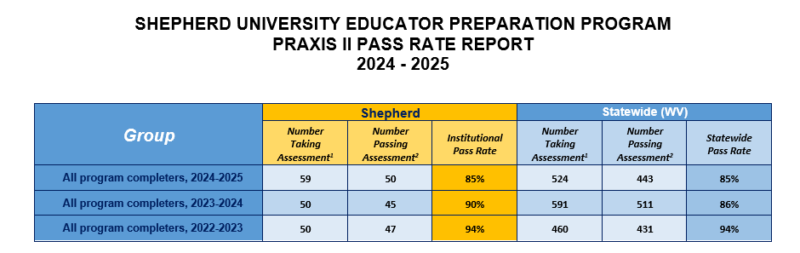
Furthermore, most candidates across the EPP continue to score in the average or above average range on the Praxis II assessment, with many scoring in the “exceeds average” range within their specializations and very few scoring “below average” in any area. Overall performance tends to be relatively consistent across the various subtests across all demographics within each specialization. In looking at the overall performance of all candidates across all programs and demographics, the data clearly demonstrates that all programs within/across the EPP adequately prepare our candidates within their various specializations, with an overall average approx. 11 points higher than that required by the state on the Praxis II content area exams, with a number of programs realizing an overall mean more than 15 points higher than the benchmark. (See documents below for supporting data.) Praxis II data clearly demonstrates the required prerequisite content coursework adequately supports development of the required content knowledge necessary to effectively teach P-12 students in all specialization areas and, therefore, provides further support for candidate competency at completion (Measure 3).
SU EPP Praxis II Content Knowledge Data Overview 2023-2025
ETS Praxis Pass Rate Report ALL 2024 – 2025

Another tool by which a candidates’ competency is evaluated during the final clinical practicum is the Skills of Teaching Observation Tool (STOT). By the end of the final practicum, candidates should be “Proficient” (scoring “3”) on most indicators on the STOT, with some variation between “2” – “4” allowed to account for the strengths and weaknesses of individual candidates. The Fall 2023 through Fall 2025 Cohorts had mean ratings of 3.52 to 3.65 as related to the components of CAEP Standard R1 on the STOT as a whole, indicating that the candidates within the EPP at Shepherd, at a minimum, were fully proficient in the knowledge and skills indicated by all InTASC Standards and CAEP Standard R1. When examining scores for individual indicators, the overall strength of Shepherd’s EPP is evident. On average, all indicators have a mean greater than “3” (“Proficient”) across all programs/demographics for Standard R1. With many candidates scoring “3.5 – 4” on the individual indicators, and an overall average of 3.59, the candidates at Shepherd demonstrate an overall rating of “exceeding proficiency” from Fall 2023 – Fall 2025 throughout the EPP across all programs/demographics as related to content and pedagogical knowledge and skills. [See “Data Overview” below.]
In addition to content and pedagogical knowledge and skills, the candidates’ understanding of their professional responsibilities must be adequately assessed by program completion to ensure they are prepared to enter the teaching profession. The Skills of Teaching Observation Tool [STOT] further provides support that candidates across the EPP at Shepherd demonstrate this professional understanding. On average, candidates across all programs/demographics have demonstrated an overall Professional Responsibility rating of “exceeding proficiency” on the STOT of 3.664 as related specifically to InTASC Standard 9 (3.72) and Standard 10 (3.6) for Fall 2023 through Fall 2025. [See “Data Overview” below.]
Overall, STOT data from the final practicum provides further evidence that teacher candidates who demonstrate the various knowledge and skills assessed by the STOT as aligned with the various InTASC/CAEP/WV Standards also successfully complete their respective programs at Shepherd and earn their teaching licensure within the State of WV. This further translates to satisfactory performance as not only teacher candidates but also beginning professionals in their respective field(s) as related to Measure 3.
SU EPP STOT Data Overview F23 – F25 (Click for Information on STOT Data across All Specializations)
STOT Assessment Guidelines (Click for Information on the STOT Assessment Tool and Guidelines)

Another measure by which the EPP at SU determines proficiency of candidate knowledge and competency at completion in all areas as well as their readiness for certification is through their ability to successfully complete the edTPA during their final clinical semester. This is both a graduation (Shepherd University / EPP) and licensure/certification requirement (EPP / State of West Virginia). Since its implementation at Shepherd as part of Measure 3, we have transitioned our candidates in each specialization towards increased success as state and national guidance has suggested. We are now operating at or above national norms across all specializations (cut scores).
edTPA Data shows that 100% of EPP completers across all programs and demographics evaluated with the edTPA during the reporting time frame (F23-F25) achieved a score higher on the edTPA than that required by either the EPP (as of F23) [mean score] or that recently mandated by the WVDE (Spring 2023). NOTE: In Fall 2024, the EPP determined to adjust the required minimum scores to those mandated by the WVDE; therefore, passing the edTPA at Shepherd University will continue to reflect the Licensure Testing requirements mandated by the WVDE state policies moving forward.
The overall mean of all candidates during the timeframe of Fall 2023 – Fall 2025 was approx. 9.5 points higher than minimum required by either the EPP at Shepherd and/or the WVDE across all edTPA exams. More than 90% of our candidates continue to achieve excellent scores on their edTPA (high/median scores), as shown below (Measure 3).
SU EPP edTPA Data Overview F23 – F25 (Click for full score reporting [Fall 2023 – Fall 2025])
The final means by which candidates’ competency at completion is highlighted for Measure 3 focuses on their critical dispositions; this is accomplished through the use of the SU Teacher Candidate Dispositional Assessment (TCDA), which is an evaluation tool initially piloted within the School of Education at Shepherd in 2022-2023. Through the use of the TCDA, the EPP is beginning to establish and monitor each candidate’s dispositions and their ability to reflect positive beliefs about the learning potentials of all P-12 students, their commitment to continued growth in cultural awareness, and their ability to reflect on their own personal biases and equitable practices. This strategy is not only a CAEP and WVDE requirement, but the practice has also been highlighted as a suggested continuous improvement area of focus from our P-12 Partner and survey/focus group feedback and EPPC workgroup reviews. Initial data from the use of the TCDA during the Pilot (S23/F23) was promising, with the majority of students and candidates at all levels “meeting expectations” across all Dispositions, programs, and demographics (Measure 3). During the full implementation of the TCDA across the EPP during the Spring 2024 and Fall 2024 semesters, entry-level education students and post-Juncture teacher candidates at all levels continued to perform well across all dispositions, with 98.99% (S24) and 97.92% (F24) scoring at the “Developing” or “Meets Expectations” across all Dispositions, programs, and demographics.
Initially, the lower scoring dispositional indicators of “Demonstrates Professionalism,” “Demonstrates Self-Regulation and Initiative,” and “Demonstrate Preparedness in Teaching and Learning” from Spring 2023 and Fall 2023 were the recommended areas of focus for continuous improvement efforts for EPP faculty in the professional/specialty course review process during the full implementation of the TCDA tool beginning in Spring 2024 and continuing into the 2024-2025 Academic Year. Students and candidates have demonstrated significant improvement in all three areas between the Pilot (S23-F23) and the first full implementation phases of the tool (S24 – F25).
Data from the full implementation period (S2024 – F2025) indicate only the areas of “Demonstrates Professionalism” and “Demonstrates Self-Regulation and Initiative” continue to be those of slight challenge, with 1.37% and 1.35% of students/candidates scoring at “Needs Improvement” (respectively) at Entrance to the program (Juncture 1 / initial Gateway). [NOTE: No candidates beyond Juncture 1 are currently scoring at “Needs Improvement” on more than one indicator for any disposition; see “TCDA Data Overview” below.] Overall, approx. 99% of students and candidates across the EPP at Shepherd earn scores indicate they are “Developing” or “Meets Expectations” across all Dispositions on the TCDA; 100% of candidates are performing at the requisite level for their programs at graduation (see below).
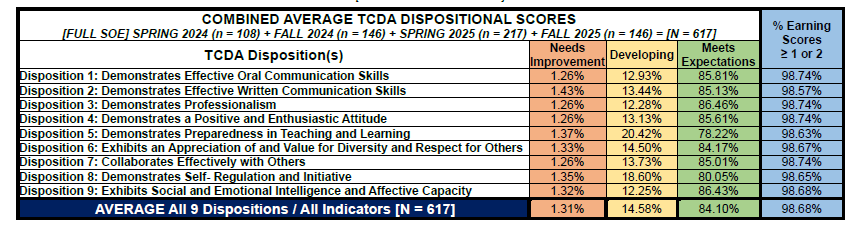
SU TCDA Data Overview S24 F24 F25 (Full Implementation — No Pilot Data)
SU TCDA Evaluation Instrument
Measure 4: Ability of Completers to be Hired in Education Positions for which They have been Prepared
The State of West Virginia has reported and is responding to an overwhelming increased teacher shortage across the state in all areas, with such initiatives as TeachWV.com and the Grow Your Own program, in which local high school students enroll concurrently in college courses during their junior and senior years of school. Shepherd University is participating in the Grow Your Own (GYO) program, and we are already and successfully “growing” future teachers and recruiting future education candidates into the EPP at SU. Between the inception of GYO at SU (F22) and Fall 2024, a total of 21 high school students enrolled in education courses as future candidates in the EPP at Shepherd through this state-sponsored program; 9% of those students also attended our “ExCITEd” high school recruitment event in the School of Education at Shepherd – one of the ongoing recruitment events of the EPP at SU.

Just as we began to conduct our own Employer Surveys and are now implementing our own Exit Surveys within the EPP, we have also begun conducting our own Alumni Surveys. However, because the State of West Virginia is similar to many other states across the country with shortages in all areas and an abundance of openings for teachers in all fields, Shepherd University’s completers are able to be hired in positions for which they have been prepared if they simply seek the opportunities provided to them. In addition to districts within West Virginia, our candidates seek employment within the local region, into Maryland, Pennsylvania, Virginia, and Washington, D.C. Anecdotally, we have also been made aware that candidates have successfully extended their job searches outside the local area, with candidates serving P-12 students in the Midwest and southwestern United States along with those who are serving in the Peace Corps, Teach for America, and beyond [Measure 4].
We began distributing our Alumni Survey in Spring 2023, using questions formerly employed by the WV HEPC as mentioned above (e.g., NeXT, Qualtrics, Skyfactor), and began directly distributing the survey to completers of the EPP ourselves rather than relying on outside entities to do so; survey distribution each year include as many completers as possible over the past five years (e.g., all those for whom we have contact information) [Measure 4]. We have continued to distribute the Alumni Survey into the 2024-2025 AY and plan to do so into the foreseeable future.
On average, based on data from Spring 2022 through Spring 2025 combined, 81% of all respondents report high satisfaction (>4) with the ability of the EPP at Shepherd to prepare them for the responsibilities they encounter in their daily work, as related to all 10 InTASC Professional Teaching Standards, with an overall satisfaction rating of 5.74 (on a scale of 1-7, with 4 being “moderately” and 7 indicating “extremely” satisfied). Approximately 75% of all respondents report overall satisfaction with the EPP at Shepherd as well as its ability to provide both the interpersonal and professional skills necessary to succeed.
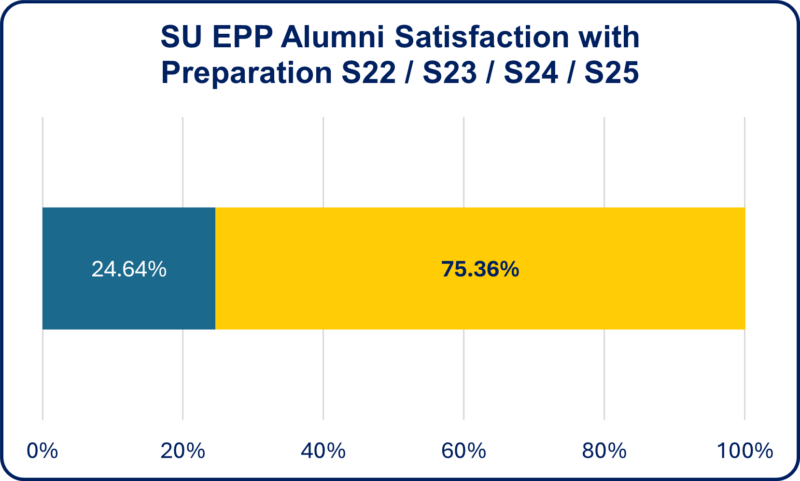
SU EPP Alumni Survey Data Overview S22-S25 (Click for an overview of the data from the combined S22-S25 data.)
Updated 3/2026 TDK