
Why Assess Learning?
How can assessment of student learning benefit Shepherd?
The university can derive many benefits from integrating a campus-wide assessment program. Academic departments have the opportunity to “take a step back”—that is, reflect on what the departmental mission is and what a graduate from that program will know, value, and be able to do. Students will find it very helpful to know the goals of the major and how each course in the program relates to those goals. Faculty will be able to use the assessment results to determine if program goals are being met. If particular goals are not being met, faculty will have specific evidence concerning what curricular changes need to be made to improve student attainment of program goals.
Academic support services, or co-curricular units, such as the Library, Student Affairs, Financial Aid, Advising, Career Services and Accessibility Services also make a tremendous contribution to student learning on campus. Whether the impact on student learning is direct or indirect, all programs can assess how they contribute to the learning community and what changes they might make to maximize that learning experience. For example, teachers teach better and students learn better in a clean, comfortable environment with adequate desks and state-of-the-art instructional resources. Students learn more about the real world when they understand the importance of paying bills online and keeping up with institutional deadlines. Everything contributes to learning.
Why do we assess?
Faculty engage in departmental assessment because assessment data facilitate improvement of academic offerings and program planning. Assessment discussions foster re-examination of values at both the departmental and institutional level; assessment also promotes interdisciplinary conversations about student learning throughout campus. Because every department and program contributes to student learning, assessment also bridges academic and student affairs. Governing boards, as well as accrediting and governmental agencies, require assessment activities to make institutions accountable to funding agencies and the public-at-large.
We already assess our students in each class they take part in as part of the major; isn’t that Enough?
Classroom, course-based assessment has always existed at Shepherd University and remains an important component of comprehensive academic assessment. However, each student in an academic major must also be assessed at, or near, the completion of the major to determine if the knowledge and skills considered to be the most important for success in the major were acquired. The goal for this assessment is not to evaluate the faculty or students but to determine if program goals were met. Grades in courses do not suffice simply because other factors than learning may contribute to the final grade given.
What do you mean by program goals?
Each academic program has skills and knowledge that program faculty believe should be mastered by all students graduating from the program. The first step to assessment in the major is for program faculty to identify and state these program goals and to make students in the major aware of them.
What are some examples of program goals?
Two examples come from the areas of music performance and teacher education. In music performance, a major program goal may be to have students successfully perform a public recital. In teacher education, an appropriate major program goal may be to have students successfully apply in a student teaching situation what they learned in their academic content and methods courses.
What other forms of assessment may be used to assess an academic major?
Two types of assessment, direct and indirect, can be used to gain information about student learning.. When assessing the major, direct forms are most reliable and valid. These methods assess the students’ knowledge and skills appropriate to the major.
Some direct forms of assessment are listed below:
| Art exhibits | Oral examinations |
| Comprehensive exams | Portfolios |
| Computer projects | Position papers |
| Field experiences | Standardized exams |
| Internships | Theater performances |
| Oral presentations | Student teaching |
| Music performances | Research Projects |
Indirect methods assess the students’ perception of their learning process. Such methods include exit interviews and surveys with current students or with program alumni.
What will be done with the assessment results?
The results of assessment at large are housed in the WEAVE database. If the results of assessment show that program goals are not being met, the appropriate faculty will use this feedback to make program revisions that will lead to better attainment of program goals.
What administrative structure has been created to manage mandated assessment activity?
Shepherd administrators believe that the implementation of a successful assessment program is of great importance. Many departments and units have appointed assessment facilitators who help to coordinate assessment at the unit or department level. A campus-wide Assessment Task Force, comprised of representatives from administration, academic support units, and departments acts as a resource for program assessment.
Is assessment mandated?
Yes, our accrediting agency, the Higher Learning Commission, expects us to continuously assess. However, our mission is to build of “culture of commitment” rather than a “culture of compliance” or “cohersion.”
What resources will be made available for departmental assessment activities?
The Center for Teaching and Learning offers grants to individuals, departments, programs and units for assessment purposes. Please see our page on assessment mini-grants. We are more than happy to help you along the way!
Why is assessment important for a department’s or academic support unit’s self-study?
Assessment results help the department or unit quantify the degree to which it is meeting the program’s learning outcomes. For example, often we have anecdotal information about our students’ success in graduate school or the job market. Assessment statistics measure that success and often help us identify specific areas where we might need to improve.
How can the university promote an atmosphere where assessment can flourish?
Critical to an assessment program that invites honest feedback is a willingness on the part of the members to assess not only what is predictable and “safe” but to explore areas in the program where assessment results may dictate revision or change. Thus, it is imperative for the university to promote an atmosphere where nobody feels that assessment results must be padded or predictable. Assessment may at times mean risk-taking– and a university that promotes this approach will reap the benefits of programs that are continually improving. Together we can establish a “Culture of Commitment.”
A. Assessment builds Successful learning Cultures
At Shepherd, we use assessment to support learning in both curricular (academic) and co-curricular (everything that happens outside of the classroom) programs and offices. Assessment for learning approaches teaching and learning as a means of creating feedback used to improve students’ performance inside and outside of the classroom. Promoting student learning is at the heart of every assessment initiative. Student learning is the common goal that drives every department and program.
Assessment has the potential to promote an atmosphere of learning, cultural diversity, and curricular innovation. Assessment of student learning can build bridges between academic and student affairs, and between academic support programs and departments. Assessment results can be used to initiate or build service and academic programs and to show how we can best utilize our resources.
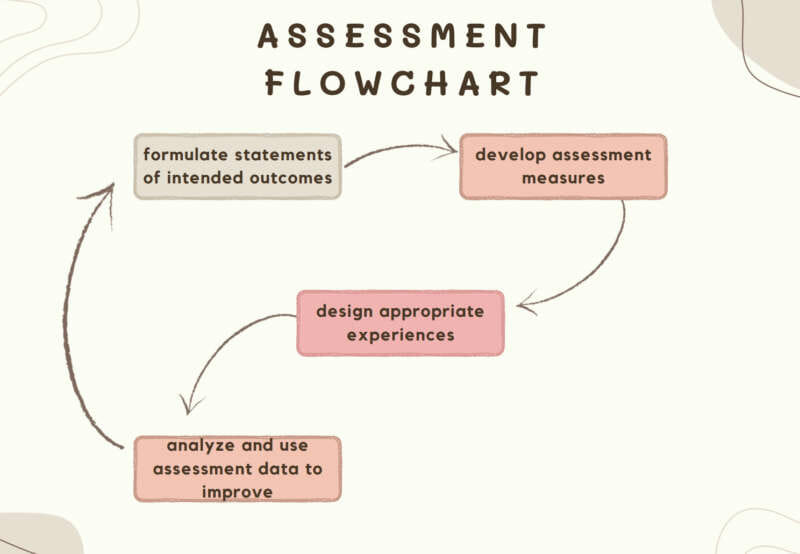
“Assessment of Student Learning is a participatory, iterative process that produces evidence that students are learning the outcomes you intended, guides you in making educational and institutional improvements, and evaluates whether changes made improve and impact student learning.” Higher Learning Commission, 2006
B. Assessment should be continuous
We support departments, programs and units to complete both formative and summative assessment since they both support each other and make the foundation for successful student learning, which is the goal of our university. The following table, based on the UK’s National Foundation for Educational Research report (NFER 2007), classifies types of formative and summative assessment as either formal or informal.
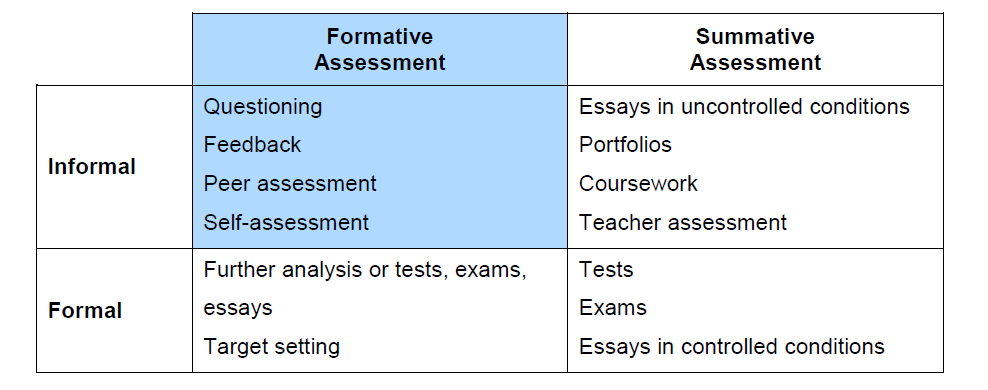
Shepherd’s cyclical university assessment of major and core courses, which happens on a 3-semester cycle of Fall, Spring, Fall, is a form of formal summative assessment. We use the results of this assessment to show stakeholders like our Board of Governors and the Higher Learning Commission that we are adding value to students’ learning and that we are consistent in our mission and vision across the university–and that is present in our classrooms and offices.
Some basic questions academic units can ask themselves to get started on assessment include:
- Plan – What do I want students to learn?
This stage includes formulating statements of Intended Learning Outcomes. - Do – How do I teach effectively?
This stage includes developing and selecting assessment measures and scaffolding appropriate experiences. - Check – Are my outcomes being met?
This stage involves evaluation of assessment data. - Act – How do I use what I’ve learned?
This stage involves reinforcing successful practices and making revisions to enhance student learning.
Some basic questions co-curricular units can ask themselves to get started on assessment include:*
- Plan – What do I want to learn about my unit?
This stage includes formulating statements of Intended Outcomes. - Do – How does my unit function most effectively?
This stage includes developing and selecting assessment measures and scaffolding appropriate experiences. - Check – Are my outcomes being met?
This stage involves evaluation of assessment data. - Act – How do I use what I’ve learned?
This stage involves reinforcing successful practices and making revisions to enhance student learning.
*Note: the questions are almost the same! We can and should talk about assessment in ALL units and programs across campus TOGETHER to build the most effective and efficient learning culture on campus that supports students, faculty and staff!
“Assessment is the intense investigation of whether our students are learning what we are teaching.” Trusteeship, 2007
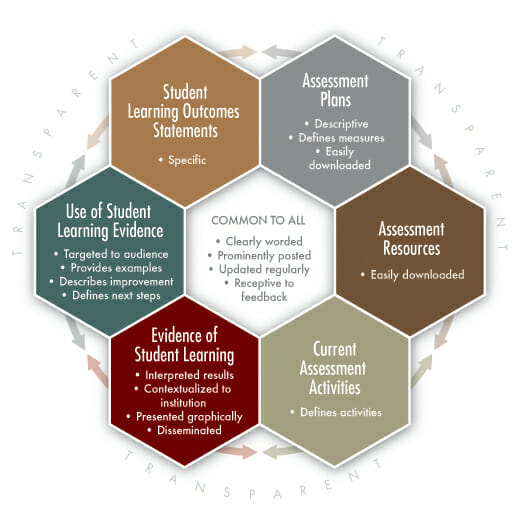
National Institute for Learning Outcomes Assessment. (2011). Transparency Framework. Urbana, IL: University of Illinois and Indiana University, National Institute for Learning Outcomes Assessment (NILOA).
C. Assessment can be rewarding
Even though assessment activities are required for each department and unit on campus, they are also a meaningful way to gather feedback on your unit. As many have discovered, assessment can actually be an interesting and rewarding process!
Assessment is flexible and approachable, meaning that you can set goals for your unit and even get funded to carry them out (i.e.: ATF mini-grants for your work!).
If you’d like some help in developing your unit’s objectives, send us an email. We’re glad to help. We’ll even give you money if you present a really good idea.
Departments and units should begin preparing a plan early on in the semester so they have a month or two to reflect on their goals and revise programs where needed. Don’t put it off; you could be denying your students or fellow staffers an opportunity to be engaged in something altogether new and exciting!
External Guides and Resources
Assessment Resources by Department or Unit
Assessment Commons
AAC&U VALUE RubricsAssessment Glossary
Direct and Indirect Measures